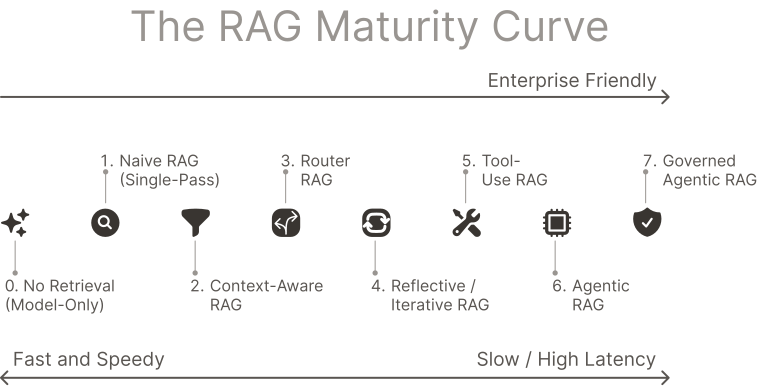
By now, most CX leaders know the architecture of a basic AI assistant: You take a user question, look up some documents, and have an LLM summarize the answer. This is RAG (Retrieval Augmented Generation).
In 2026, most RAG conversations are stuck in the wrong place. Teams are still obsessing over retrieval quality—better vectors, better chunking, bigger context windows.
In real enterprise CX workflows, retrieval is largely a solved problem. The bigger differentiator—and the reason so many pilots fail to graduate to production—is the Decide step in the agentic loop.
The Loop: Observe → Decide → Act → Learn
If you’ve read the Cast post on spotting agentic AI slideware vs. real, governable agents, you know the core distinction: A system isn’t "agentic" just because it uses an LLM. It is agentic because it can run a controlled loop with guardrails, tools, and measurable outcomes.
For a CX leader, that loop looks like this:
The "Decide" step can be implemented with strict rules, LLMs, Machine Learning, or a mix.
In practice, LLM decisioning often comes first because it works immediately with zero training data. However, Rules and ML come later to enforce safety. You cannot rely on an LLM to "feel" if a refund violates compliance policy—you need a deterministic decision gate.
Below is a maturity ladder you can use to sanity-check any RAG or Agentic claim.
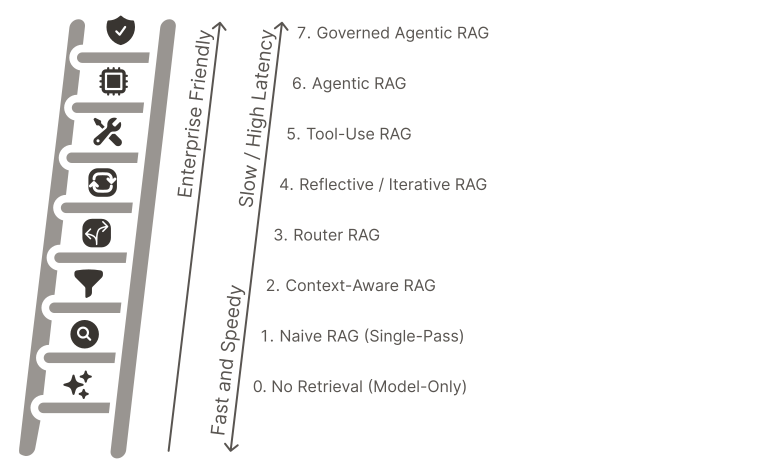
Meaning: The system answers using only its pre-trained weights (its "frozen memory") without looking up any external data. The Reality: Great for creative writing or general coding help, but usually a non-starter for enterprise CX. It has no knowledge of your private data, your customer's specific contract, or the policy change you made this morning.
Example:A customer asks, "Why is my bill higher?" The model hallucinates a generic reason like "maybe a promotional period ended" because it cannot see the actual invoice. It is fast, but it is effectively guessing.
Meaning: Often called "Standard RAG," this is a single search against a vector database that pulls the few most relevant passages, inserts them into the prompt, and drafts an answer. The Reality: In 2025, this is a liability. It is better than "model-only" hallucination, but it is fragile.
Example: A customer asks the agent: “Can we renew for two years with a 10% discount?”The system pulls the standard discount policy, but misses the customer’s amendment capping discounts at 5% without Finance approval and the auto-renew notice window. It confidently answers “Yes—10% is fine,” sending the renewal conversation down the wrong path.
Meaning: Same shape as Standard (Single-Pass) RAG, but with basic quality controls: better chunking, metadata filters, and citations. This is the minimum bar for "repeatably useful."
Example: For a renewal-risk question, the system filters the search to only include the customer’s specific segment, SKU, and contract version. It cites the specific clauses used, reducing the chance of mixing up Enterprise and Standard terms.
Meaning: The system decides which library to search before searching. This prevents "wrong-corpus" answers, which are the #1 silent failure in enterprise RAG.
Example: "Why did my renewal price change?" A semantic router sends this query to the Contracts & Billing Policy index instead of dumping it into the generic Product Documentation index. It retrieves invoice logic, not feature descriptions.
Meaning: Retrieval becomes multi-step: Search → Detect Gaps → Refine Query → Search Again. It mimics a human analyst doing follow-up research.
Example: "Show expansion opportunities."
Meaning: The system stops relying on text alone and connects to Systems of Record (APIs, Databases) for structured truth. This transforms the agent from "Read-Only" to "Read-Write."
Example: "Are we on track for renewal?" The agent queries the CRM for the renewal date, the CS platform for open escalations, and the Product Telemetry DB for active user counts. It uses retrieval only for the narrative, not the numbers.
Meaning: A controller runs the loop end-to-end. It plans steps, chooses sources, checks its own output, and repeats if needed. This is where you see workflow completion, not just Q&A.
Example: "Prep an Executive Business Review." The agent gathers data, drafts the storyline, validates key numbers via APIs, identifies risks, proposes next actions, and flags exactly what it cannot prove—asking the human for that specific input instead of guessing.
Meaning: Agentic capability wrapped in Deterministic Policy. The agent can plan and act, but strict "Policy Gates" prevent it from taking unsafe actions. This is the difference between a demo and something you can deploy to 10,000 customers.
Example: The agent autonomously drafts a renewal offer (Agentic), but a Hard Rule blocks it from sending if the "Customer Sentiment Score" is below 40 or if the discount exceeds 15% without VP approval (Governed).
Getting to the top of this ladder usually comes with a trade-off: Speed. Standard agents that use tools (Level 5+) are often slow. They have to wake up, query Salesforce, wait for the API, query the usage DB, wait for the SQL join, and then start thinking. In a live customer interaction, that latency is a killer.
At Cast, we solved this with an architecture we call Context Injection.
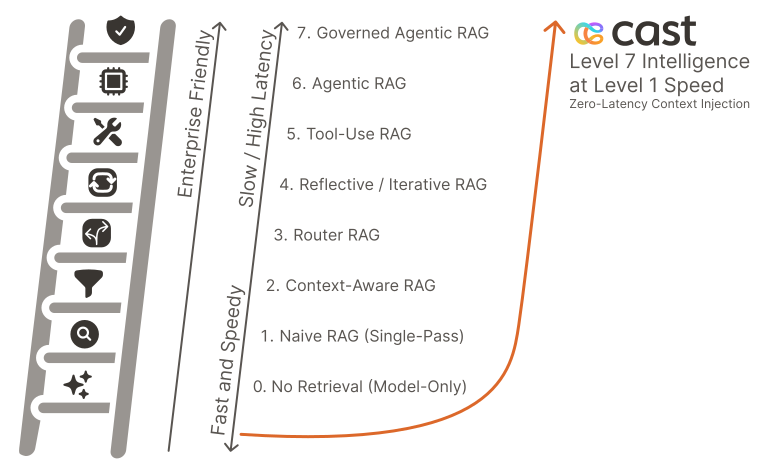
Instead of making the agent fetch data during the conversation, we pre-compute the entire "State of the Customer" beforehand.
We run complex joins across your CRM, CS platform, Data Warehouse (Snowflake/Databricks), and Support tickets, caching a rich JSON profile for every contact.
Why the helps? No customer wants to wait minutes for an answer. You can think of context injection as a cache for every user and decision-maker across all accounts.
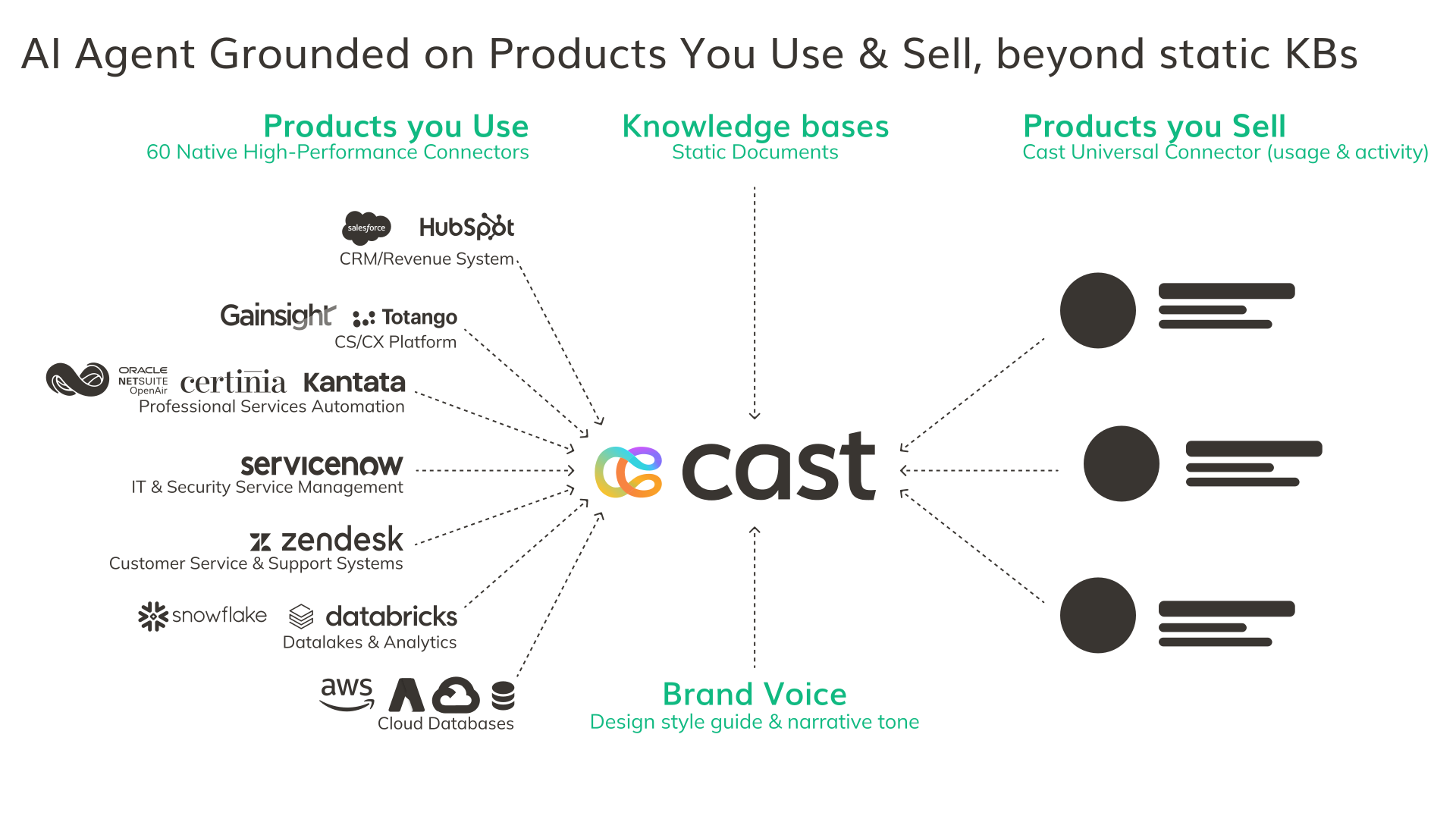
When the agent observes a user, it doesn't need to ask "Who is this?" or "Is their renewal at risk?"—the answers are already injected into its brain.
This gives you Level 5, 6, and 7 capabilities with Level 1 speed.
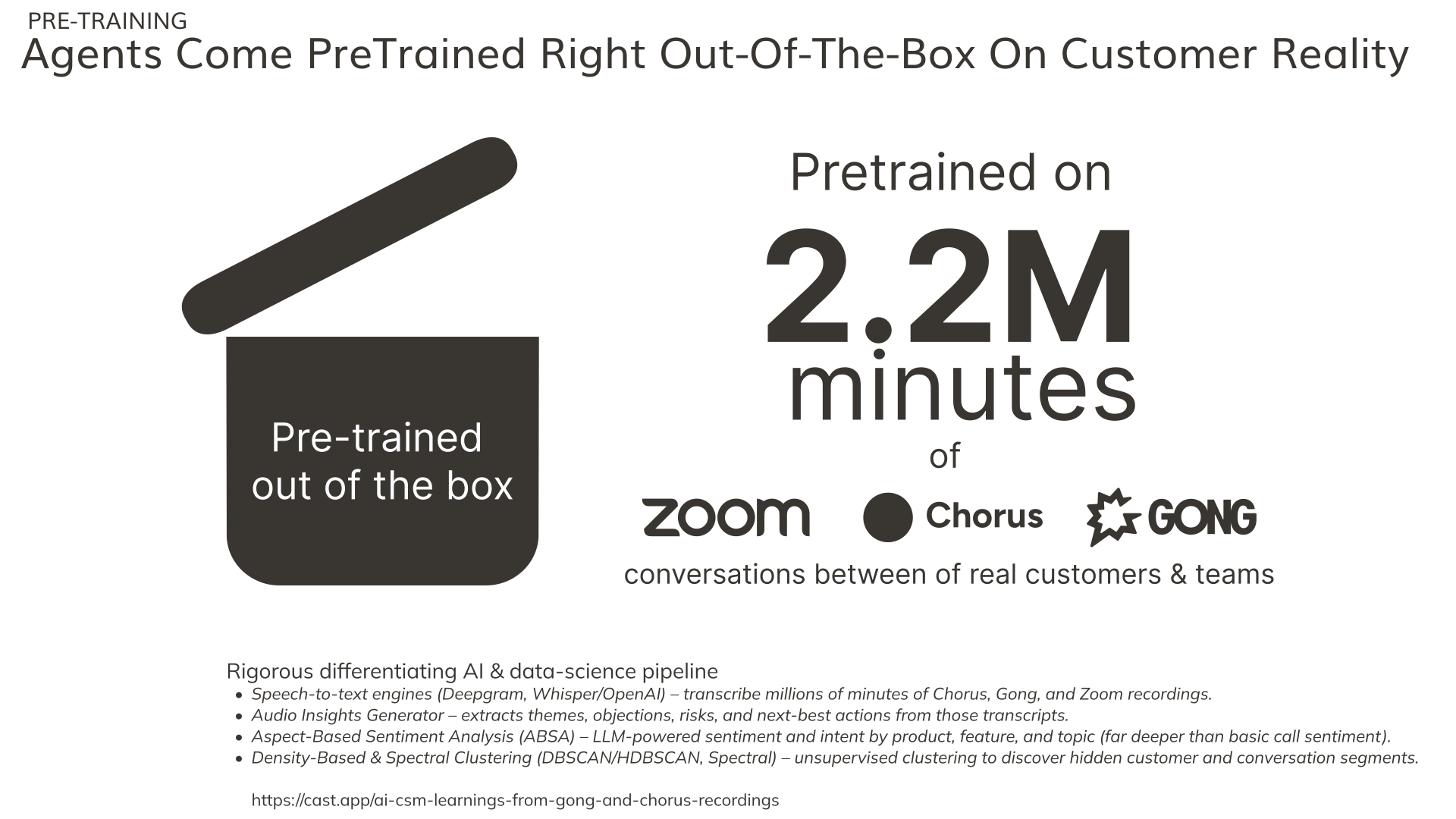
We don't just start from zero. Cast agents come pre-trained on 2.2 million minutes of real enterprise customer conversations (from Gong, Chorus, and Zoom). They already know what a "renewal objection" sounds like and how to navigate a "pricing dispute" before they even ingest your specific data.
RAG maturity isn't about how many embeddings you have. It is about how well your system Decides and Learns.
In the Learn step (Observe → Decide → Act → Learn), the agent’s output becomes a new data source. If an agent successfully resolves a tricky renewal question, that "solution path" should be saved back to the knowledge base or customer profile.
If someone pitches you an "Agentic" solution that is mostly diagrams and vibes, use the ladder above to ask one simple question:
"Show me the Decide step: What controls it, what constrains it, and how does it learn from its mistakes?"
Stop building Single-Pass / Naive RAG and start deploying governed, high-speed agents that actually drive revenue. Talk to us at Cast to see how we turn your disparate data into a decision engine that learns from your best enterprise outcomes.
Talk to Cast.